
Congratulations to HE graduate Suzanna Dryden, who has been offered a place to undertake a doctorial study at the University of Oxford.
Suzanna studied a Foundation Degree in Children’s Development and Learning with us – validated by the University of Reading, one of our Higher Education Partners.
We spoke to her about the course, her experiences, and how she’s got to where she is now.
What stood out most about your experience on the Foundation Degree in Children’s Development and Learning?
There are many things which stood out to me during my time on the Foundation Degree in Children’s Development and Learning. Returning to education as a mature learner was quite daunting, and despite the challenge and difficulties, I found the experience to be both validating and motivating. This was only possible because of fantastic support from the course lecturers and my peers. It was a privilege to study with so many wonderful people holding similar experiences.
Why did you choose to join the course?
Having felt for a long time the limits of opportunity available to me, I was keen to find some sort of career progression. It wasn’t feasible for me to take a traditional HE degree full time, but the Foundation Degree (FD) was a great way to gain HE qualifications and continue to work alongside it. I also felt the content of the course would complement what I was already doing and hoped it would lead to greater career opportunities.
Crucially, the structure of the FD was what sold it to me, as I would be able to continue working while studying, at a college not far from where I lived, and with fees much lower than other HE courses. When you have a family and work, the importance of convenience and accessibility cannot be understated.
How has your career progressed since completing the course, and how did the qualification help shape that journey?
Since completing the FD my role has changed from Senior Teaching Assistant to Science Technician. However, the most significant progression has been academic rather than professional. I am currently in the final year of my MSc in Education (Research Design and Methodology) at the University of Oxford and have been offered a place on its doctoral programme.
The FD was critical to this journey and I’m really proud to have used this pathway. It provided the foundational knowledge needed to engage with educational theory, developed my academic and critical thinking skills, and, importantly, gave me the confidence to pursue further study in higher education. I’ve also been acutely conscious of the emphasis the FD places on reflective practice. To continually reflect on practice and improve is a fundamental approach for an educator, I’ve since found that it’s also a critical to academic work.
What inspired you to pursue a PhD at the University of Oxford and how have you dealt with challenges?
My academic studies have reinforced for me the importance and impact of evidence-informed research. I’m particularly interested in pursuing a career in education research, and a PhD represents a natural next step towards this goal. Through my MSc of Oxford, I have had the opportunity to engage with the vibrant academic community and gained insight into its research in practice. It’s further strengthened my aspirations for a career in education research, and to do this at Oxford is a bit of a dream.
The journey has not been without challenges. Alongside my academic work, I have balanced significant personal and professional demands including supporting my children through their GCSEs, A-Levels, diplomas, and university, while working and progressing through my own FD, BA and MSc. I have had significant health issues which almost derailed my MSc and have also navigated a persistent sense of imposter syndrome. I often question my place here but remind myself that each journey offers unique insights that contribute meaningfully to how education is understood and studied. I manage feelings of inadequacy by focusing on my own development and the quality of my work, rather than comparison with others. I’ve also learned to be quite reflective and reflexive, focusing on the positives of these experiences, and what I can control, or what I need to change for it to work.
Even so, balancing my studies has required considerable discipline and effective time management. I’ve learned however, to prioritise my wellbeing and family, which provide essential stability and perspective. I’ve learned that it’s important to be kind to myself. I have also been incredibly fortunate to benefit from strong peer and supervision support at every stage, and I have greatly valued being part of a community of passionate and committed students.
What are you hoping to achieve through your Doctor of Philosophy in Education, and what impact would you like to make in the field?
To date, my research has focused on elevating children’s voices as a marginalised group, leading to a broader interest in how marginalised voices are recognised across education. I’m still committed to children’s rights and the importance of their voices, but my doctoral research will instead examine FDs. It hopes to explore the experiences of teaching support staff, recognising them as highly skilled professionals whose contributions are often underrepresented in policy and research.
I want to examine the transformative potential of FDs, particularly for learners from non-traditional backgrounds. This in part draws on my own experience and reasons for using the FD pathway. It intends on analysing FD design and impact across policy, implementation, and individual experience, with the aim of contributing to academic and policy discussions around professional recognition and development.
Ultimately, I aim to demonstrate the value of FDs in widening participation, supporting social mobility, and providing structured progression pathways, as well as their potential role in addressing challenges in teacher recruitment. I will be delighted if the research raises the profile of FDs which then leads to expansion of opportunities for others to benefit from them like I did.
—
This vocational award is a work-based course, and your assignments and lessons are all designed to benefit your professional development. You’ll build upon your experience through modules in areas such as child development, safeguarding, creativity and critical thinking, and working in partnership with parents. College sessions include lectures, as well as tutorials and seminars. The course also incorporates a great deal of group work, which will be an opportunity to share experiences with fellow professionals working in a range of settings.
It is aimed at early years and education practitioners who are working with children up to the age of 18 and requires you to be released from your setting to attend Berkshire College of Agriculture (BCA) for a twilight session once a week. (1.15pm until 7.30pm).
Click here to find out more information about the course.
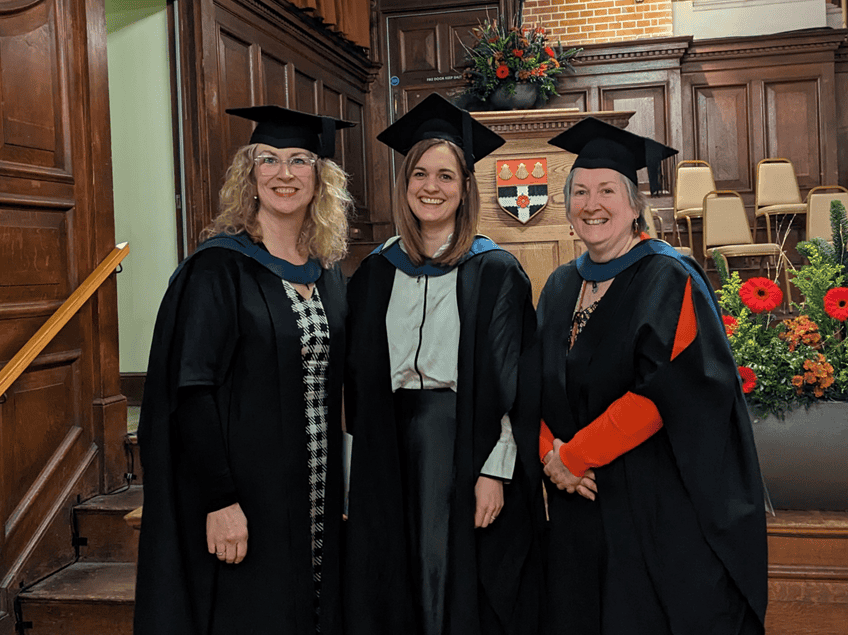
Suzanna, centre, pictured alongside her two course tutors on her graduation day